
1. What Are ASME B16.5 Flanges and Why Do They Matter?
1.1 Understanding Size Limits (NPS 1/2 to NPS 24)
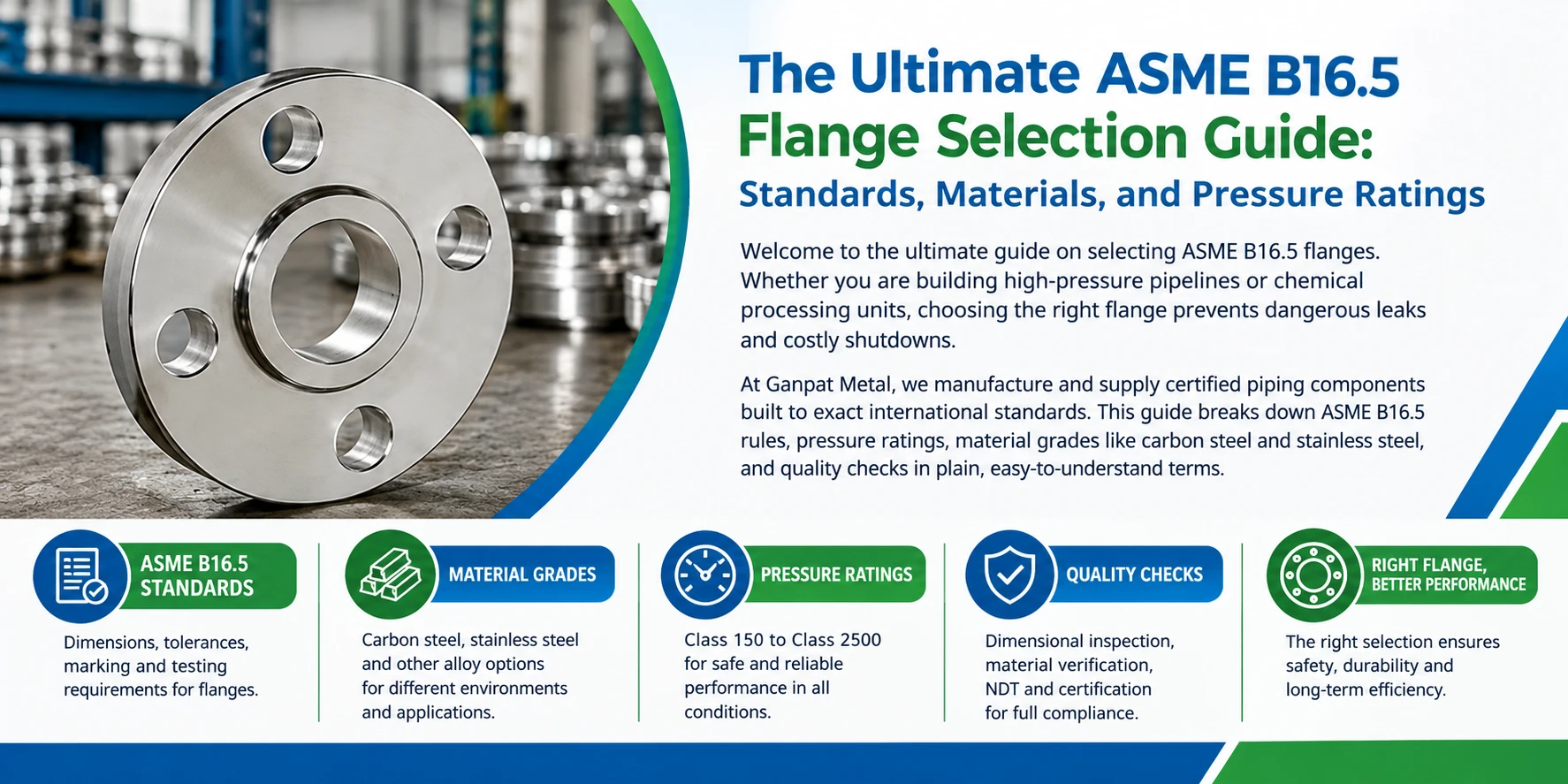
The ASME B16.5 rulebook sets the global standard for pipe flanges and fittings. It covers physical dimensions, pressure limits, material types, and testing rules. This specific standard applies to sizes from NPS 1/2 to NPS 24 (small to medium piping). If you need massive flanges larger than 24 inches, engineers use a different rulebook called ASME B16.47.
1.2 Decoding Pressure Classes (Class 150 to 2500)
ASME B16.5 divides flanges into seven strength categories called Pressure Classes: Class 150, 300, 400, 600, 900, 1500, and 2500. Think of these classes as strength ratings. The higher the class number, the more pressure the flange can safely handle.
1.3 Choosing the Right Flange Face (Raised Face, Flat Face, RTJ)
Flanges connect by pressing two faces together with a gasket in between to stop leaks.
Raised Face (RF)
The most common design. It features a small raised ring around the hole that bites into the gasket when bolted tight.
Flat Face (FF)
Completely flat across the entire surface. Used mostly with weaker materials like cast iron to prevent cracking.
Ring Type Joint (RTJ)
Features a small machined groove holding a solid metal ring. Built for extreme high-pressure systems.
2. Core Flange Types Used in Piping Systems
2.1 Weld Neck Flanges for High Pressure
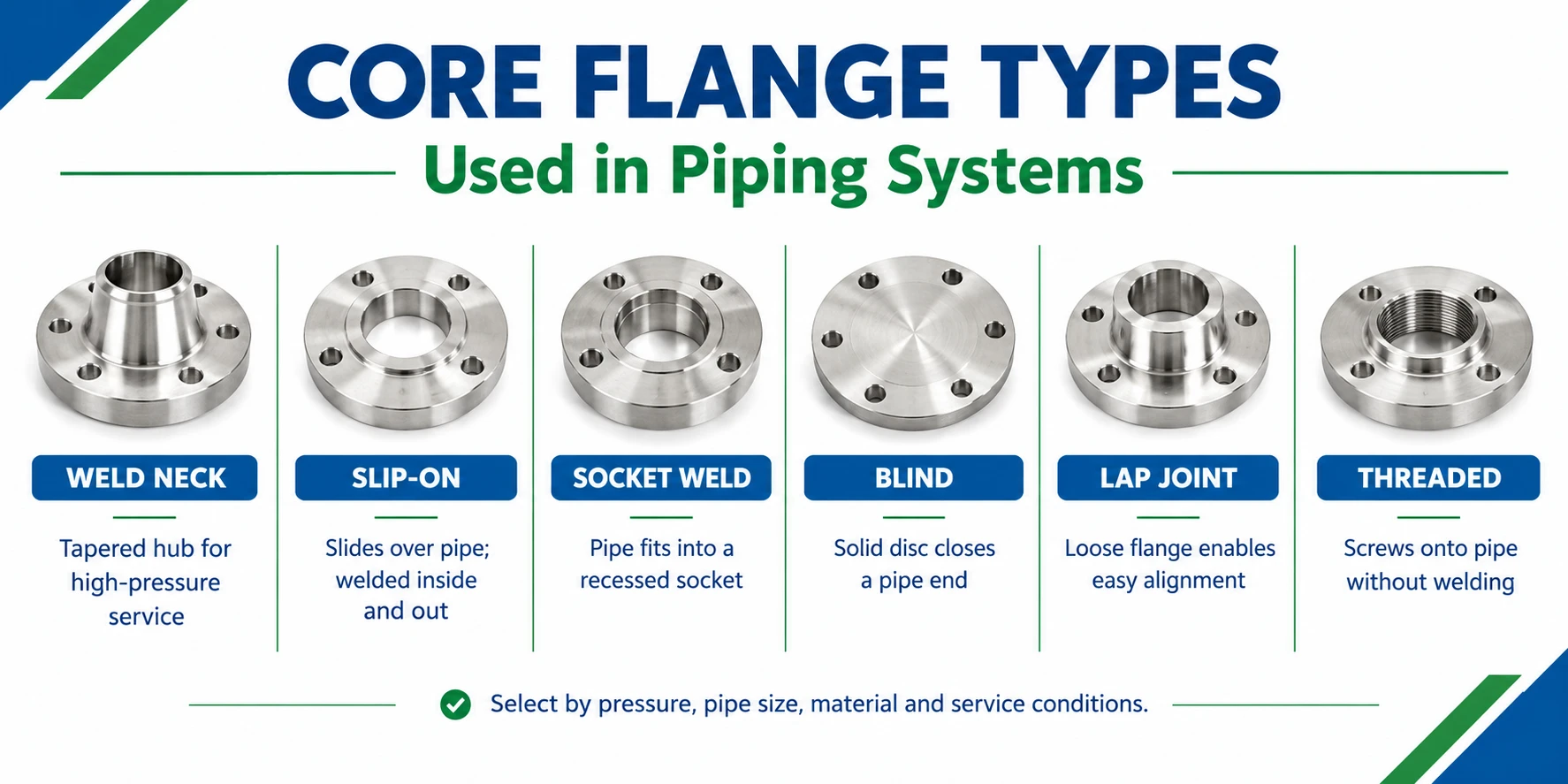
Weld Neck flanges have a long, sloping hub that connects directly to the pipe with a full weld. This shape spreads out stress evenly, making them the safest choice for high-pressure lines and shaking pipes.
2.2 Slip-On and Socket Weld Flanges for Easy Installation
Slip-On Flanges
Slide right over the outside of the pipe and get welded on the inside and outside. They are very popular because they are easy to line up during assembly.
Socket Weld Flanges
Feature a small internal pocket where the pipe slides in before getting welded on the outside. They are mainly used for smaller-diameter, high-pressure pipes.
2.3 Blind, Lap Joint, and Threaded Flanges
Blind Flanges
Solid steel disks with no center hole. They are bolted onto the end of a pipe or vessel nozzle to seal it completely.
Lap Joint Flanges
Used with a stub end welded to the pipe. The flange ring spins freely, making bolt alignment quick and easy.
Threaded Flanges
Screw directly onto the pipe without any welding. They are used in low-pressure lines or hazardous areas where welding sparks are dangerous.
3. How Heat Changes Flange Pressure Limits (Thermal Derating)
3.1 The Truth About Class 150 Ratings
A common mistake is thinking a Class 150 flange can always hold 150 pounds of pressure. In reality, steel loses strength as it gets hot. When operating temperatures go up, the maximum allowable pressure goes down—a concept engineers call thermal derating.
3.2 Why Flanges Leak at High Temperatures
A standard carbon steel Class 150 flange holds up to 285 psi at room temperature. However, if the system heats up to 600°F (315°C), that same flange can only hold 140 psi. Ignoring this drop in strength causes gaskets to blow out and joints to leak.
To learn how to calculate safe pressure limits under heat, read our detailed guide on how operating temperature affects flange pressure limits.
3.3 Pressure-Temperature Comparison Table
| Operating Temperature | Class 150 Carbon Steel (A105) | Class 150 Alloy Steel (A182 F11) | Class 150 Stainless Steel (SS 316) | Class 300 Carbon Steel (A105) |
|---|---|---|---|---|
| Room Temp (38°C 100°F) | 285psi | 290psi | 275psi | 740psi |
| 200°C (392°F) | 200psi | 260psi | 195psi | 675psi |
| 400°C (752°F) | 95psi | 170psi | 140psi | 570psi |
ASME B16.5 Pressure–Temperature Derating Calculator
Calculate allowable working pressure at your operating temperature according to ASME B16.5 Table 2, evaluate design pressure compliance, and check automated class recommendations.
Operating Parameters
Calculation Results
Thermal Derating Curve
Dynamic ASME B16.5 PlotASME B16.5 Pressure-Temperature Ratings Table
Standard ReferenceRatings are derived from ASME B16.5 Table 2 standard data. Intermediate temperature values are linearly interpolated in accordance with ASME rules. Metric (bar) values are direct equivalents for reference. Always cross-check project specifications and Mill Test Certificates (MTC) before procurement.
4. Forged Carbon Steel: Choosing Between A105 and Low-Temp Grades
4.1 Standard ASTM A105 Carbon Steel Forgings
ASTM A105 is the most common forged carbon steel used for normal water, steam, and oil lines up to 800°F (427°C). It is strong and affordable for everyday plant use.
4.2 Preventing Cold Cracks with ASTM A350 LF2
Standard A105 steel can become brittle and crack like glass in freezing weather or sub-zero processes. If a system operates below -29°C (-20°F), engineers must upgrade to ASTM A350 LF2, which is specifically tested to stay tough in extreme cold.
For more details on cold-weather material choices, check out our guide on low-temperature impact testing and ASTM A350 LF2 selection.
4.3 High-Yield Carbon Steels for Pipelines (ASTM A694)
Long-distance oil and gas pipelines use high-strength carbon steel grades like ASTM A694 (F46, F52, F60). These grades handle higher internal pressure without needing unnecessarily thick, heavy metal walls.
5. Stainless Steel Flanges: Preventing Rust and Weld Decay
5.1 SS 304 vs. SS 304L (Avoiding Weld Decay)
Standard stainless steel (SS 304) contains carbon. When welders heat it up during assembly, carbon bonds with chromium, causing a problem called weld decay where the metal rusts right next to the weld. Choosing low-carbon SS 304L stops this from happening.
Learn how to protect welded pipe joints in our technical article on preventing intergranular corrosion and weld decay in stainless steel.
5.2 SS 316 vs. SS 316L (Added Molybdenum for Marine Environments)
Adding a dash of molybdenum to SS 316 and SS 316L makes it much more resistant to salt water, harsh chemicals, and chloride pitting. It is the go-to grade for marine and chemical plants.
5.3 Sanitary and Electropolished Finishes
For food, beverage, and pharmaceutical plants, stainless steel surfaces are polished smooth (electropolished) so bacteria and residue cannot stick to the metal.
6. High-Nickel Alloys (Hastelloy) for Aggressive Chemicals
6.1 Understanding PREN (Pitting Resistance Numbers)
When dealing with acids that destroy normal stainless steel, metallurgists use a math formula called PREN (Pitting Resistance Equivalent Number) to score how well an alloy resists chemical eating. Higher numbers mean better protection.
6.2 Selecting Hastelloy C276, C22, and B2 for Acid Service
Hastelloy C276
Excellent against wet chlorine gas and strong acid mixtures.
Hastelloy C22
Features extra chromium for superior resistance to heavy oxidizing acids.
Hastelloy B2
Built specifically to handle pure hydrochloric acid without breaking down.
Explore chemical compatibility charts in our specialized resource on selecting high-nickel alloys for severe chemical corrosion.
6.3 Extreme Heat Alloys (C2000, C4, X)
Advanced nickel alloys like C2000, C4, and Hastelloy X are used in extreme industrial furnaces and specialized chemical reactors where regular metals melt or dissolve.
7. Quality Control and Verifying Mill Test Certificates (MTC)
7.1 Reading Physical Flange Rim Markings
Every legal ASME B16.5 flange must have permanent stamps on its outer rim showing the manufacturer logo, standard name, size, pressure class, material grade, and a unique heat tracking number.
7.2 Checking EN 10204 3.1 Test Certificates to Avoid Rejections
When Ganpat Metal ships piping products, we provide an EN 10204 3.1 Material Test Certificate. Quality inspectors check this paper against the physical flange markings to verify the exact chemical makeup and steel strength.
Avoid failed inspections by following our step-by-step instructions on auditing EN 10204 3.1 mill test certificates.
7.3 Material Testing (PMI and NDT)
Important projects often require extra testing, such as Positive Material Identification (PMI) gun scans to prove metal grades, and Ultrasonic Testing (UT) to check for internal flaws.
8. Proper Flange Installation, Gaskets, and Bolt Torque
8.1 Picking the Right Gasket
Gaskets fill microscopic gaps between flange faces. Spiral-wound gaskets (metal mixed with flexible graphite) are best for high-pressure, hot lines, while soft rubber or PTFE gaskets work well for low-pressure chemical lines.
8.2 Choosing High-Strength Stud Bolts (ASTM A193 B7)
Flange bolts must handle immense tension. Standard high-pressure setups use ASTM A193 Grade B7 alloy steel studs because they do not stretch or snap under heavy loads.
8.3 The Star Pattern Tightening Method
Never tighten flange bolts in a circle. Technicians must use a star-pattern sequence and tighten bolts in gradual steps (30%, 60%, 100%). This ensures the gasket gets squeezed evenly, preventing leaks and warped flange faces.