
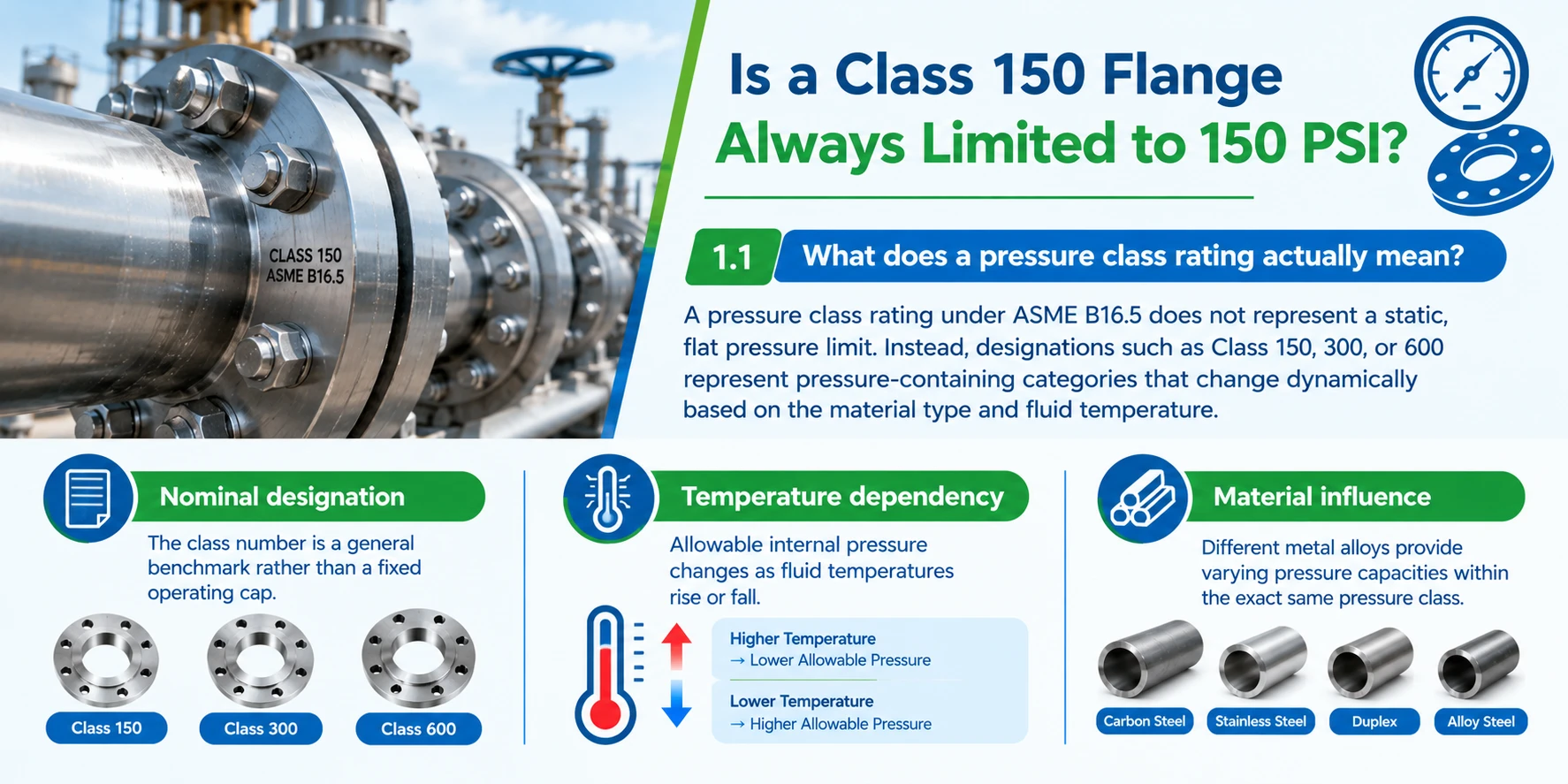
1. Is a Class 150 Flange Always Limited to 150 PSI?
1.1 What does a pressure class rating actually mean?
A pressure class rating under ASME B16.5 does not represent a static, flat pressure limit. Instead, designations such as Class 150, 300, or 600 represent pressure-containing categories that change dynamically based on the material type and fluid temperature.
Nominal designation
The class number is a general benchmark rather than a fixed operating cap.
Temperature dependency
Allowable internal pressure changes as fluid temperatures rise or fall.
Material influence
Different metal alloys provide varying pressure capacities within the exact same pressure class.
1.2 Why can a Class 150 flange hold 285 PSI at room temperature?
Many operators are surprised to learn that a standard Class 150 carbon steel flange can safely handle up to 285 psig at ambient room temperature. The ASME B16.5 standard calculates room-temperature ratings with a built-in safety factor based on cold material yield strength.
Ambient capability
Cold steel possesses high tensile strength, allowing higher internal pressure.
Safety factor
Standard pressure tables build in structural buffers for room-temperature operations.
Baseline benchmark
Room-temperature ratings reflect the maximum mechanical strength of unheated metal.
1.3 Why do steam lines and thermal oil piping leak at high heat?
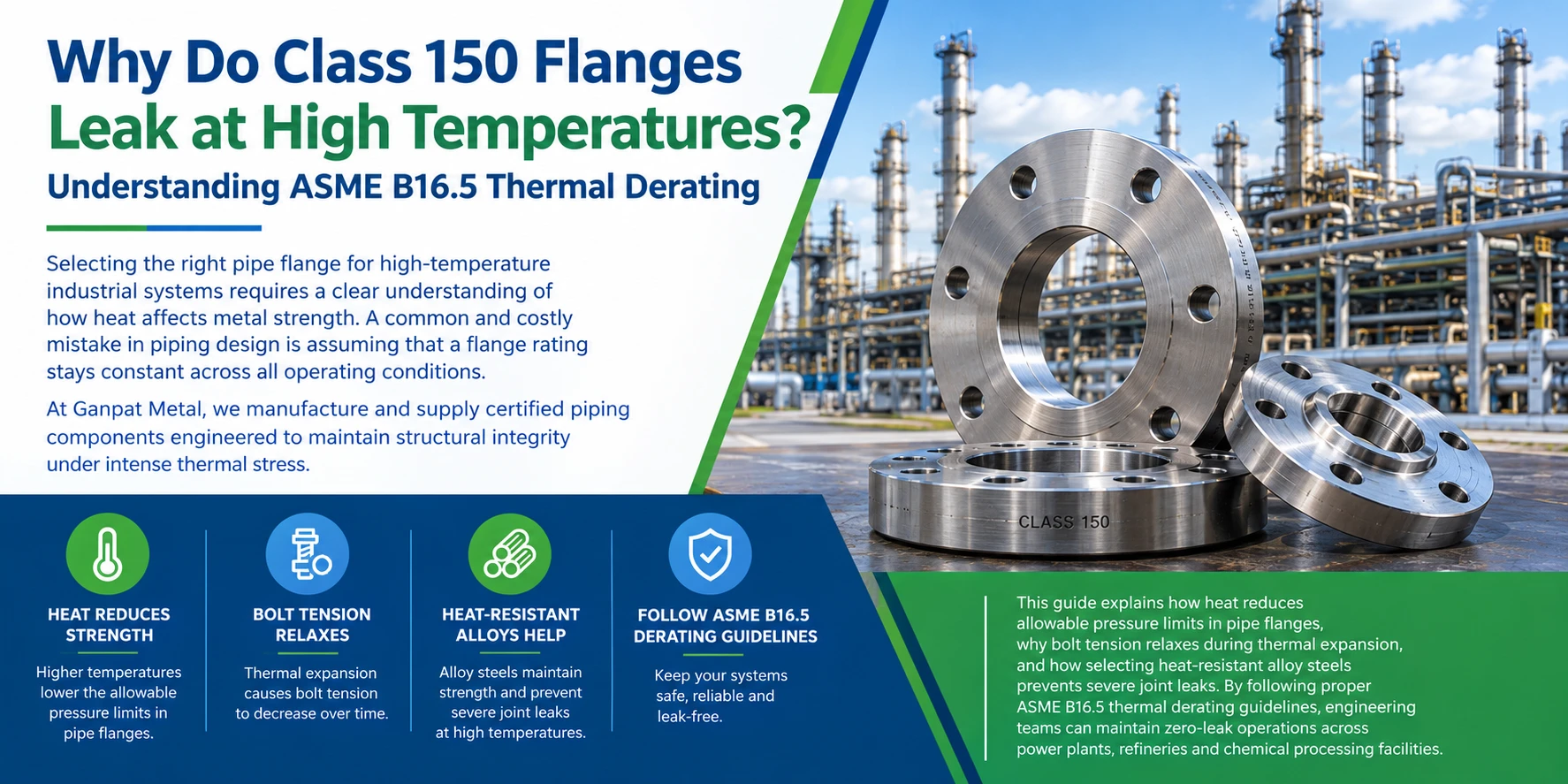
Joint leaks occur when high-temperature steam or thermal oil lines operate near cold-pressure thresholds without accounting for thermal derating. As heat passes through the pipe wall, the flange material loses tensile strength, causing gasket seal pressure to drop.
Seal pressure loss
Reduced metal strength allows internal system pressure to push past gasket surfaces.
Thermal expansion shock
Rapid temperature changes expand flange faces unevenly, creating tiny leak paths.
Gasket blowout risk
Operating unrated flanges at elevated heat leads to gasket degradation and fluid leaks.
2. Why Does Steel Lose Strength When It Gets Hot?
2.1 How elevated heat lowers metal yield strength and tensile limits
At a molecular level, heat increases atomic vibration within steel, weakening the metallic bonds holding the crystal structure together. As temperature increases, the force required to stretch or deform the steel drops significantly.
Yield strength drop
Heated metal deforms under lower mechanical stress than cold steel.
Tensile reduction
Ultimate load-carrying capacity decreases as operational heat increases.
Structural softening
Prolonged exposure to high heat reduces the overall stiffness of the flange body.
2.2 Why do flange bolts loosen when piping systems heat up?
Flange bolts and stud assemblies undergo thermal relaxation when subjected to continuous heat. Because stud bolts, flange hubs, and gaskets expand at slightly different rates, internal bolt tension drops, reducing the clamping force holding the joint together.
Differential expansion
Flanges and bolts expand at different rates, changing net clamp loads.
Bolt tension loss
Heated studs stretch slightly, reducing the squeezing pressure applied to the gasket.
Flange face tilting
Uneven thermal expansion causes flange faces to tip outward, breaking the face seal.
2.3 What is metal creep and how does it cause gasket blowouts?
Metal creep is the slow, permanent deformation of solid materials subjected to long-term mechanical stress at high temperatures. In flanged joints, creep causes stud bolts to stretch permanently over time, leading to gradual pressure loss and sudden gasket blowouts.
Permanent stretching
Stud bolts slowly elongate under continuous high-temperature stress.
Gasket load degradation
Creep reduces the seating load necessary to keep semi-metallic gaskets tight.
Catastrophic blowout
Sudden pressure spikes push past creep-weakened gasket seals.
3. How Much Pressure Can Carbon Steel Hold as Temperature Rises?
3.1 Looking at ASME B16.5 Group 1.1 pressure limits for standard carbon steel
Standard ASTM A105 carbon steel belongs to ASME B16.5 Material Group 1.1. While highly effective for general utilities, carbon steel experiences a steep decline in pressure capacity once operating temperatures pass 200°C (392°F).
Group 1.1 classification
Covers standard forged carbon steels used in general piping networks.
Thermal threshold
Material strength begins dropping rapidly above 200°C (392°F).
Maximum temperature cap
Standard carbon steel usage is restricted above 425°C (800°F) due to graphitization.
3.2 How fast does allowable working pressure drop from ambient to 600°F?
The drop in working pressure across temperature levels is significant. A Class 150 carbon steel flange rated at 285 psi at room temperature drops to 200 psi at 200°C, and down to just 140 psi at 315°C (600°F)—cutting its pressure capacity by more than half.
Ambient rating
285 psig (19.6 bar) at temperatures up to 38°C (100°F).
Mid-temp rating
200 psig (13.8 bar) at 200°C (392°F).
High-temp rating
140 psig (9.7 bar) at 315°C (600°F).
ASME B16.5 Pressure–Temperature Derating Calculator
Calculate allowable working pressure at your operating temperature according to ASME B16.5 Table 2, evaluate design pressure compliance, and check automated class recommendations:
Operating Parameters
Calculation Results
Thermal Derating Curve
Dynamic ASME B16.5 PlotASME B16.5 Pressure-Temperature Ratings Table
Standard ReferenceRatings are derived from ASME B16.5 Table 2 standard data. Intermediate temperature values are linearly interpolated in accordance with ASME rules. Metric (bar) values are direct equivalents for reference. Always cross-check project specifications and Mill Test Certificates (MTC) before procurement.
3.3 How do alloy steels and stainless steels compare under high heat?
Alloy steels containing chromium and molybdenum retain their mechanical strength much better than standard carbon steel at elevated temperatures. Stainless steels maintain moderate pressure ratings at high heat but expand more rapidly, requiring careful gasket selection.
Chrome-Moly alloys
Retain high yield strength and resist thermal creep at extreme temperatures.
Stainless grades
Offer superior oxidation resistance but experience higher thermal expansion rates.
Selection balance
Choosing the right alloy prevents unexpected pressure class upgrades.
4. When Should You Switch from Carbon Steel to Alloy Steel Flanges?
4.1 What happens when carbon steel reaches its maximum safe temperature?
When carbon steel operates continuously above its thermal design limit, carbide structures within the metal begin transforming into graphite flakes. This internal change weakens the steel, making it susceptible to sudden brittle failure under thermal shock.
Graphitization risk
Long-term high heat causes internal carbon structures to degrade.
Micro-cracking
Thermal fatigue creates microscopic cracks around flange bolt holes.
Code disqualification
ASME guidelines mandate switching to alloy grades for severe thermal service.
4.2 How do Chrome-Moly alloys prevent thermal deformation?
Adding chromium and molybdenum to forged steel creates Chrome-Moly alloys. Chromium enhances oxidation and corrosion resistance, while molybdenum increases high-temperature creep strength, preventing flange distortion under intense heat.
Chromium benefit
Protects flange faces from scaling and high-temperature oxidation.
Molybdenum benefit
Locks the internal crystal structure to prevent high-temperature creep.
Thermal stability
Maintains uniform face alignment across extreme thermal cycles.
When system heat passes carbon steel safety limits, piping engineers upgrade to heat-resistant alloy steel F11 forged flanges for high-temperature lines or specialized ASTM A182 F5 chrome-moly flanges for refinery steam service to ensure long-term mechanical reliability.
Enhanced creep resistance
Chrome-moly alloys hold tight bolt loads at temperatures above 500°C.
Refinery compliance
Satisfies strict petrochemical specifications for high-heat process piping.
Long service life
Reduces maintenance cycles and prevents joint leakage in thermal loops.
4.3 Which alloy steel grade works best for high-pressure power plant boilers?
Power plant boiler lines, superheaters, and main steam headers require specialized alloy grades like F9 or F91. These high-alloy materials maintain high tensile strength and resist thermal fatigue under extreme pressures and temperatures exceeding 550°C.
For extreme heat exchanger loops that need maximum creep resistance, design teams specify high-temperature F9 alloy steel piping components to prevent joint warping and maintain code compliance.
High-alloy stability
Delivers exceptional tensile strength in critical superheater piping loops.
Fatigue resistance
Endures repeated boiler startup and shutdown thermal cycles without cracking.
Code approved
Fully compliant with ASME Section I boiler and pressure vessel requirements.
5. How Do You Stop High-Pressure Transmission Lines from Leaking Under Thermal Expansion?
5.1 Why do high-pressure pipelines need high-yield forging grades?
Cross-country transmission pipelines and high-pressure oil and gas headers endure intense internal pressure surges alongside environmental temperature changes. Standard forgings would require excessively thick walls to handle these combined stresses, making high-yield alloys necessary.
Surge protection
High yield thresholds absorb sudden internal pressure spikes without deforming.
Weight reduction
High-yield materials allow thinner wall designs without sacrificing pressure capacity.
Bending resistance
Resists ground movement and thermal expansion forces in long pipeline runs.
For demanding high-pressure headers that experience intense thermal expansion, engineers specify high-yield A694 F46 pipeline forgings alongside heavy-duty ASTM A694 F52 high-pressure pipeline flanges to maintain strong joint bolt tension under extreme operational loads.
Micro-alloyed strength
Delivers yield strengths up to 52,000 psi for demanding transmission service.
Tight seal retention
Prevents flange face tilting and bolt loosening during high-volume transfers.
Pipeline compliance
Meets strict API and ASME standards for cross-country line construction.
5.2 How do high-yield alloys resist bolt stretch during thermal cycles?
High-yield forging grades match the thermal expansion characteristics of high-strength line pipe. By expanding and contracting at the same rate as the connected pipe, these materials minimize internal stress on stud bolts and prevent joint relaxation.
Matched expansion
Keeps thermal expansion rates uniform across the entire welded joint assembly.
Constant bolt load
Minimizes changes in stud tension as line temperatures rise and fall.
Zero joint distortion
Prevents localized flange warping during rapid flow changes.
When transmission lines require maximum yield strength to handle internal pressure surges, contractors rely on heavy-duty A694 F60 high-yield transmission flanges to ensure complete structural stability across major pipeline distribution hubs.
Extreme yield threshold
Delivers a minimum yield strength of 60,000 psi for critical headers.
Surge resistance
Engineered to withstand extreme pressure fluctuations in major fuel lines.
Field weldability
Precision-manufactured chemical ratios ensure clean field butt-welding.
5.3 How do you properly torque flange bolts to prevent thermal leaks?
Proper bolt installation is essential for high-temperature flange performance. Technicians must use lubricated high-strength studs (such as ASTM A193 Grade B7 or B16) and apply torque incrementally using a star pattern to ensure uniform gasket compression.
Incremental torqueing
Apply bolt torque in gradual stages (30%, 60%, 100%) to compress gaskets evenly.
Cross-pattern sequence
Tighten bolts in a star pattern to keep flange faces parallel during assembly.
Hot torque verification
Re-check bolt torque after initial thermal stabilization to compensate for gasket relaxation.
6. How Does Ganpat Metal Ensure Flanges Withstand High-Temperature Service?
6.1 How to calculate maximum working pressure for your operating temperature
At Ganpat Metal, our technical sales team assists engineers in selecting the correct pressure class and material grade based on their specific operating parameters. We cross-reference your working fluid temperature against ASME B16.5 rating tables to guarantee code compliance.
Parameter evaluation
Analyzing operating pressure, fluid heat, and environmental conditions.
Rating verification
Confirming that chosen material classes provide adequate safety margins.
Custom recommendations
Advising on material upgrades to avoid unnecessary over-specification.
6.2 Why are EN 10204 3.1 test certificates critical for high-heat applications?
High-temperature applications leave no room for material traceability errors. Every high-temperature flange supplied by Ganpat Metal arrives with a complete EN 10204 3.1 Material Test Certificate documenting chemical composition, heat treatment logs, and elevated-temperature tensile test results.
Chemical verification
Confirming exact chromium, molybdenum, and carbon levels.
Heat treatment proof
Documenting normalizing and tempering furnace cycles.
Full traceability
Linking physical flange rim stampings directly to certified mill test reports.
6.3 Why do engineering teams trust Ganpat Metal for heat-resistant piping solutions?
Global contractors and facility engineers partner with Ganpat Metal because we maintain strict quality control standards, extensive factory inventory, and fast dispatch capabilities. Our commitment to precision manufacturing ensures that your high-temperature piping systems operate safely without costly joint leaks or unplanned shutdowns. To review complete dimensional tables, pressure classes, and material groups across all piping categories, return to our master ASME B16.5 flange dimension and rating guide.
Ready inventory
Extensive stock of carbon, alloy, and stainless steel flanges ready for immediate dispatch.
Certified manufacturing
Fully compliant with international ASME, ASTM, and API quality standards.
Technical support
Experienced engineering support to assist with material selection and thermal calculations.