
1. The Hidden Danger of Sub-Zero Piping (Why Carbon Steel Cracks)
1.1 Why normal steel shatters like glass in freezing weather
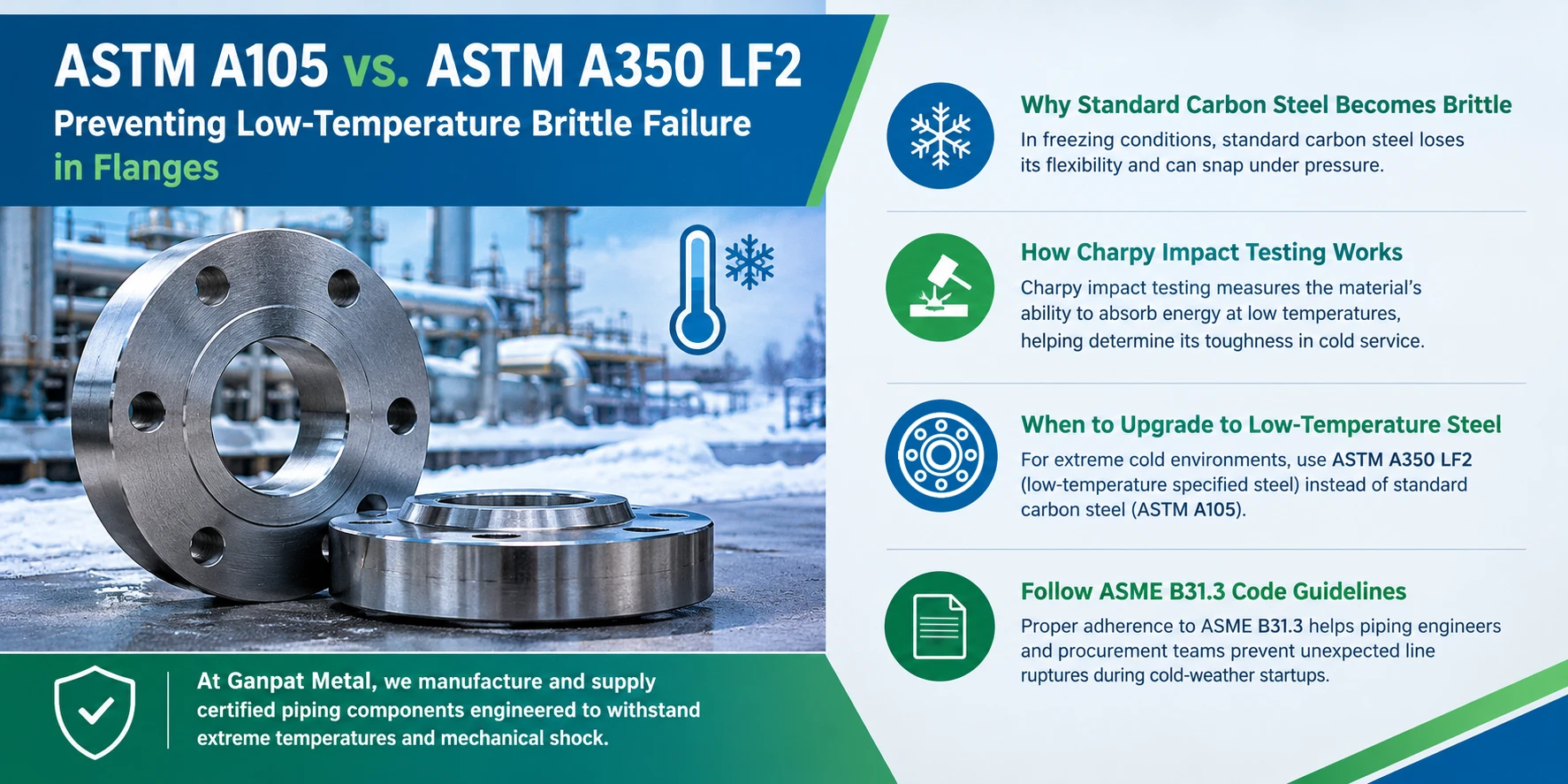
Steel behaves differently as ambient operational temperatures drop during winter conditions. At room temperature, standard carbon steel is ductile and absorbs shock before bending. In freezing climates, the atomic lattice within the metal becomes rigid and shatters under sudden pressure spikes.
Ductile state
Metal absorbs impact by stretching and deforming safely under mechanical stress.
Brittle state
Metal cracks instantly along internal crystal boundaries with zero warning.
Operational risk
Unprepared line components fail catastrophically during sudden thermal shifts.
1.2 Real-world hydrotest failures during winter plant startups
Field maintenance logs from process engineers highlight recurring failures during cold-weather hydrostatic testing. Piping systems filled with cold test fluid can rupture along flange hubs or bolt holes if the metal lacks certified notch toughness.
Test pressure risks
Cold fluid stress causes unrated steel to crack during initial pressurization.
Winter startup hazards
Thermal expansion shocks cold metal joints when hot media enters cold lines.
System downtime
A single cracked flange forces complete plant depressurization and costly repairs.
1.3 The science of Ductile-to-Brittle Transition Temperature (DBTT)
Metallurgists measure cold behavior using the Ductile-to-Brittle Transition Temperature (DBTT). Above this critical point, steel breaks in a safe, ductile manner with visible bending. Below this thermal threshold, the exact same metal suffers sudden brittle fracture without any pre-warning deformation.
High impact zone
Steel absorbs heavy mechanical energy above the DBTT limit.
Transition zone
Steel strength drops rapidly across a narrow temperature window.
Brittle fracture zone
Steel breaks cleanly under minimal mechanical shock below the DBTT limit.
2. Standard ASTM A105 Carbon Steel: Where It Works and Where It Fails
2.1 What ASTM A105 is designed for (normal and warm utility lines)
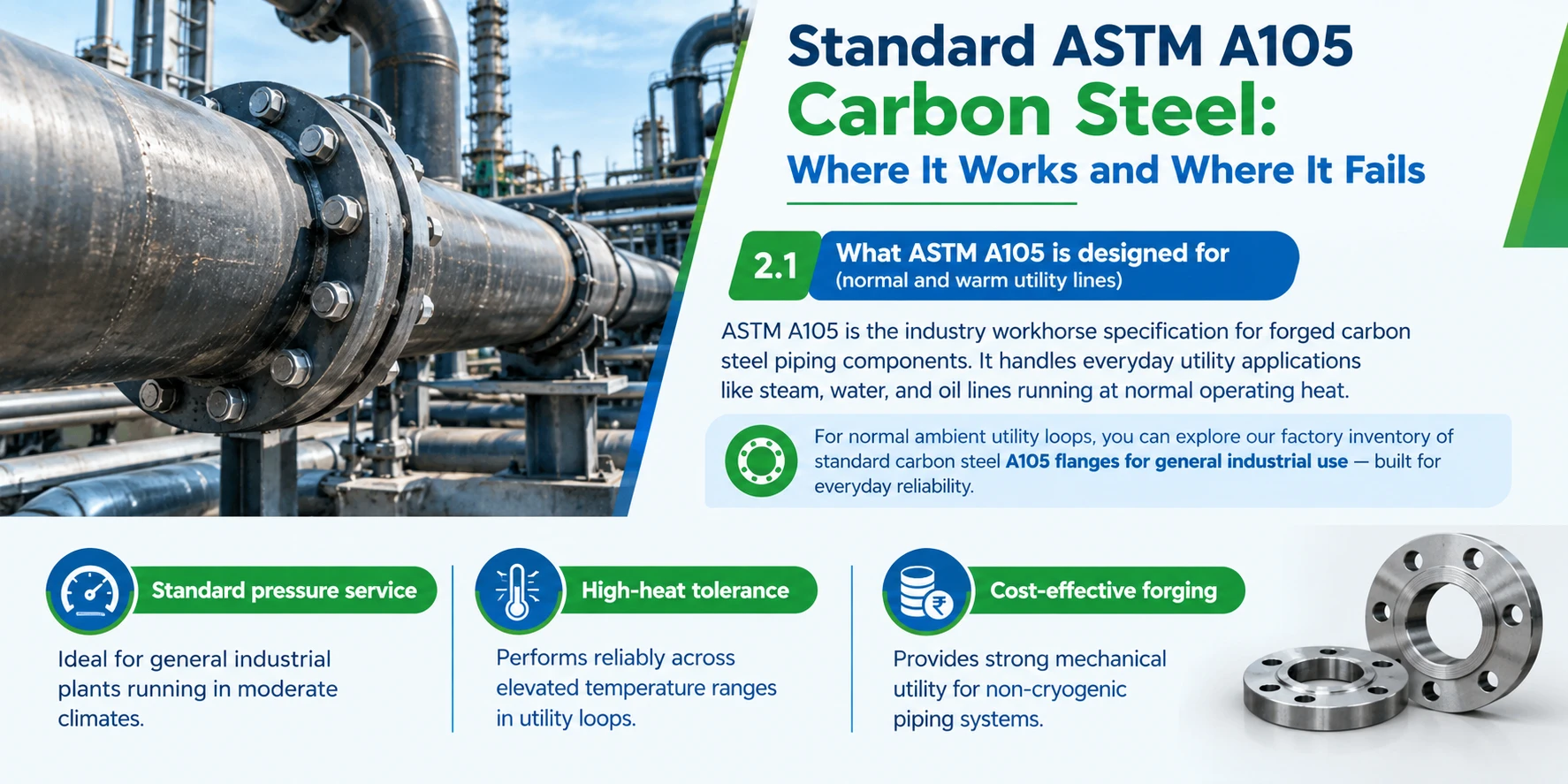
ASTM A105 is the industry workhorse specification for forged carbon steel piping components. It handles everyday utility applications like steam, water, and oil lines running at normal operating heat. For normal ambient utility loops, you can explore our factory inventory of standard carbon steel A105 flanges for general industrial use built for everyday reliability.
Standard pressure service
Ideal for general industrial plants running in moderate climates.
High-heat tolerance
Performs reliably across elevated temperature ranges in utility loops.
Cost-effective forging
Provides strong mechanical utility for non-cryogenic piping systems.
2.2 Why standard A105 lacks guaranteed cold-weather toughness
Standard production rules for A105 do not require factory impact testing. Unless custom heat treatments are added, standard forgings cannot guarantee ductile strength in freezing conditions.
Non-impact tested
Base specifications omit low-temperature shock testing by default.
Variable grain structure
Un-normalized cooling creates mixed crystal sizes that crack in frost.
Sub-zero risk
Installing standard forgings in freezing weather creates unmonitored safety gaps.
2.3 Understanding ASME B31.3 temperature limits and code rules
The ASME B31.3 Process Piping Code sets strict rules for Minimum Design Metal Temperature (MDMT). Code guidelines disqualify standard untreated forgings when design temperatures cross below standard sub-zero cutoffs.
MDMT compliance
Design engineers must verify lowest expected metal heat levels before spec approval.
Curve exemptions
Code rules require impact tests when wall thickness increases in cold zones.
Safety mandates
B31.3 enforces material upgrades when systems drop below ambient limits.
3. Upgrading to ASTM A350 LF2 Class 1 Forged Flanges
3.1 Controlled chemistry: How lower carbon keeps steel tough
To keep steel ductile in severe frost, metallurgists refine the chemical composition. ASTM A350 LF2 limits carbon levels and balances manganese ratios to prevent internal brittle structures.
Lower carbon content
Prevents hard, brittle micro-structures from forming during forging.
Manganese balancing
Improves structural toughness and refines internal grain boundaries.
Clean alloy recipe
Lowers trace impurities to maintain ductility in severe cold service.
3.2 Normalizing heat treatment: Why factory processing matters
Unlike standard forgings cooled naturally on shop floors, every A350 LF2 flange undergoes furnace normalization. The steel is reheated to precise thermal limits and air-cooled to rebuild a uniform internal crystal grain structure.
Grain refinement
Re-crystallizes the steel matrix into tiny, uniform structural grains.
Stress relief
Removes internal manufacturing stresses that trigger cold cracking.
Toughness locking
Guarantees uniform impact resistance throughout the entire flange body.
3.3 Comparing standard utility steel with cold-service forgings
Upgrading from standard utility forgings to low-temperature specified materials keeps piping networks fully code-compliant. When sub-zero safety margins apply, engineers rely directly on our certified ASTM A350 LF2 low-temperature forged flanges designed to eliminate brittle failure risks.
Temperature rating
LF2 covers sub-zero operations where standard A105 fails safety codes.
Certified testing
Every LF2 batch includes mandatory lab test proof before dispatch.
Code approval
Fully satisfies ASME B31.3 low-temperature process line requirements.
4. Proving Cold Toughness with Charpy V-Notch Testing
4.1 What is a Charpy V-Notch impact test? (The swinging hammer test)
To prove steel will not shatter in cold service, lab technicians conduct Charpy V-Notch (CVN) impact testing. A heavy pendulum hammer swings down and strikes a chilled, notched steel bar to measure absorbed energy.
Chilled sample
Metal test bars are cooled to exact sub-zero thermal levels before testing.
Controlled strike
A weighted pendulum releases from a fixed height to strike the specimen notch.
Energy calculation
The machine records exact mechanical energy absorbed by the breaking steel.
4.2 Testing at low thermal limits for code compliance
Mandatory impact testing for A350 LF2 Class 1 proves the metal absorbs heavy mechanical shock without shattering. Three standardized V-notched metal bars are cut from the forging batch, held in sub-zero liquid baths, and struck within seconds to record accurate energy limits.
Specimen preparation
Machine-cut sample bars ensure exact dimensional accuracy for lab testing.
Thermal conditioning
Liquid immersion baths maintain strict sub-zero temperature control.
Impact execution
High-speed pendulum strikes provide instant absorbed energy measurements.
4.3 Reading impact energy values on test reports & Calculator Widget
Material test certificates display temperature levels, absorbed impact energy, and ductile fracture percentages. Knowing how to read these certified test reports helps quality control inspectors verify that every delivered component satisfies job site mechanical specifications.
Low-Temperature Metal Selector & MDMT Calculator
Use the calculator below to determine whether standard carbon steel or low-temperature specified steel is required for your operating environment:
Operating Parameters
Specification & Code Recommendation
ASME B31.3 Material Toughness & DBTT Operating Plot
Live Status Plot5. Building a Complete Low-Temperature Piping Loop
5.1 Matching low-temperature flanges with compatible line pipe
A low-temperature system is only as reliable as its weakest component connection. When building cold-service header systems, connect your flanges with high-quality seamless ASTM A333 Grade 6 carbon steel line pipe to guarantee uniform structural toughness across every welded joint.
Material matching
Pair LF2 forgings with impact-tested line pipe to eliminate weak links.
Uniform expansion
Matching metal chemistries ensures even expansion and contraction across welds.
Complete safety loop
Guarantees total cold-weather compliance from header to terminal valve.
5.2 Gasket and bolting selection for freezing temperature lines
Flanges require cold-rated stud bolting and flexible seals to maintain tight joint loads as metals shrink. Selecting specialized alloy hardware prevents stud loosening and ensures zero leakage across variable thermal cycles.
Low-temp alloy studs
Use specialized stud bolting engineered to maintain tension in frost.
Heavy hex nuts
Pair with impact-tested nuts to prevent thread stripping under thermal contraction.
Flexible spiral gaskets
Install resilient gaskets that adjust to flange face movement without leaking.
5.3 Preventing stress risers and sharp notches during field welding
Sharp notches, weld undercuts, or heavy tool marks create localized stress points where cold cracks initiate. Welders must use low-hydrogen electrodes and maintain proper preheat controls to guarantee clean, defect-free joint transitions.
Low-hydrogen rods
Use moisture-controlled electrodes to prevent hydrogen-induced cracking.
Preheat control
Maintain proper preheat temperatures to avoid rapid weld zone chilling.
Smooth contouring
Grind out sharp profile angles to eliminate mechanical stress points.
6. Ganpat Metal’s Quality Standards for Cold-Service Flanges
6.1 Verifying Minimum Design Metal Temperature (MDMT) before ordering
At Ganpat Metal, our technical team checks your design pressure, fluid media, and climate conditions before production begins. This thorough engineering review prevents material specification errors and ensures your project receives fully compliant components.
Spec verification
Cross-referencing operational parameters against ASME code minimums.
Material guidance
Recommending cost-effective material upgrades only when design safety requires it.
Precision sizing
Confirming exact dimensional specs for seamless field alignment.
6.2 Complete EN 10204 3.1 certification and low-temp test logs
Every low-temperature flange shipped by Ganpat Metal arrives with verified mill test documentation. Quality inspectors can easily cross-reference physical heat numbers on the flange rim directly with our certified lab reports.
Heat traceability
Matching physical flange rim stamps directly to paper inspection logs.
Chemical analysis
Confirming exact carbon, manganese, and trace element percentages.
Impact logs
Displaying certified Charpy V-Notch test results performed on your specific material heat.
6.3 Why engineering teams trust Ganpat Metal for severe frost-zone projects
Engineers and procurement teams partner with Ganpat Metal because we maintain strict quality control and dependable global supply chains. Our ready inventory of normalized cold-service components ensures fast dispatch for critical plant maintenance and new builds. To review complete dimensional standards, pressure ratings, and material groups across all piping categories, return to our master ASME B16.5 flange selection guide.
Stock availability
Ready inventory of normalized cold-service forgings for rapid delivery.
Zero-defect quality
Rigorous inspection protocols ensure every item passes QA audits cleanly.
Global compliance
Manufacturing components fully certified to international engineering standards.