
Why Do Standard Stainless Steels Fail in Severe Acid Service?
How aggressive chemicals destroy passivating oxide layers
Austenitic stainless steels like SS 304L and SS 316L rely on a microscopic, self-healing chromium oxide film to prevent corrosion. However, halogen ions—such as chlorides and fluorides—and strong reducing acids penetrate and strip this protective passive film away. Once the oxide layer dissolves, bare metal is directly exposed to corrosive attack.
Film breakdown
Concentrated acids strip the passive chromium oxide coating faster than it can reform.
Localized pitting
Chlorides breach weak spots in the oxide skin, drilling microscopic holes deep into the pipe wall.
Rapid wall thinning
Continuous exposure to strong reducing acids leads to uniform chemical dissolution of the metal.
Real-world plant corrosion failures in sulfuric and hydrochloric lines
Field maintenance reports from chemical processing facilities frequently highlight joint failures around flange faces and weld seams. In hot sulfuric or hydrochloric acid service, standard stainless flanges experience localized crevice corrosion beneath gaskets, causing sudden acid leaks and dangerous environmental spills.
Gasket crevice attack
Acid becomes trapped in tiny gaps between the gasket and flange face, accelerating localized attack.
Weld zone cracking
Thermal stress and heat exposure during welding create grain boundaries vulnerable to chemical attack.
Unexpected pinhole leaks
Pitting corrosion penetrates through flange hubs without showing obvious outer surface rust.
The limits of standard austenitic stainless steels in chemical processing
While SS 316L performs exceptionally well in mild industrial chemicals and water treatment, its low molybdenum content provides insufficient protection against aggressive media. Concentrated hydrochloric acid or hot sulfuric acid rapidly eats through standard stainless grades, requiring a transition to high-nickel superalloys.
Low molybdenum threshold
Standard stainless grades lack sufficient molybdenum to withstand strong reducing acids.
Chloride vulnerability
Exposure to chloride concentrations causes rapid stress corrosion cracking in standard grades.
Temperature sensitivity
Moderate increases in chemical fluid temperature exponentially increase corrosion rates on standard steel.
How Do You Evaluate Metal Resistance to Localized Pitting?
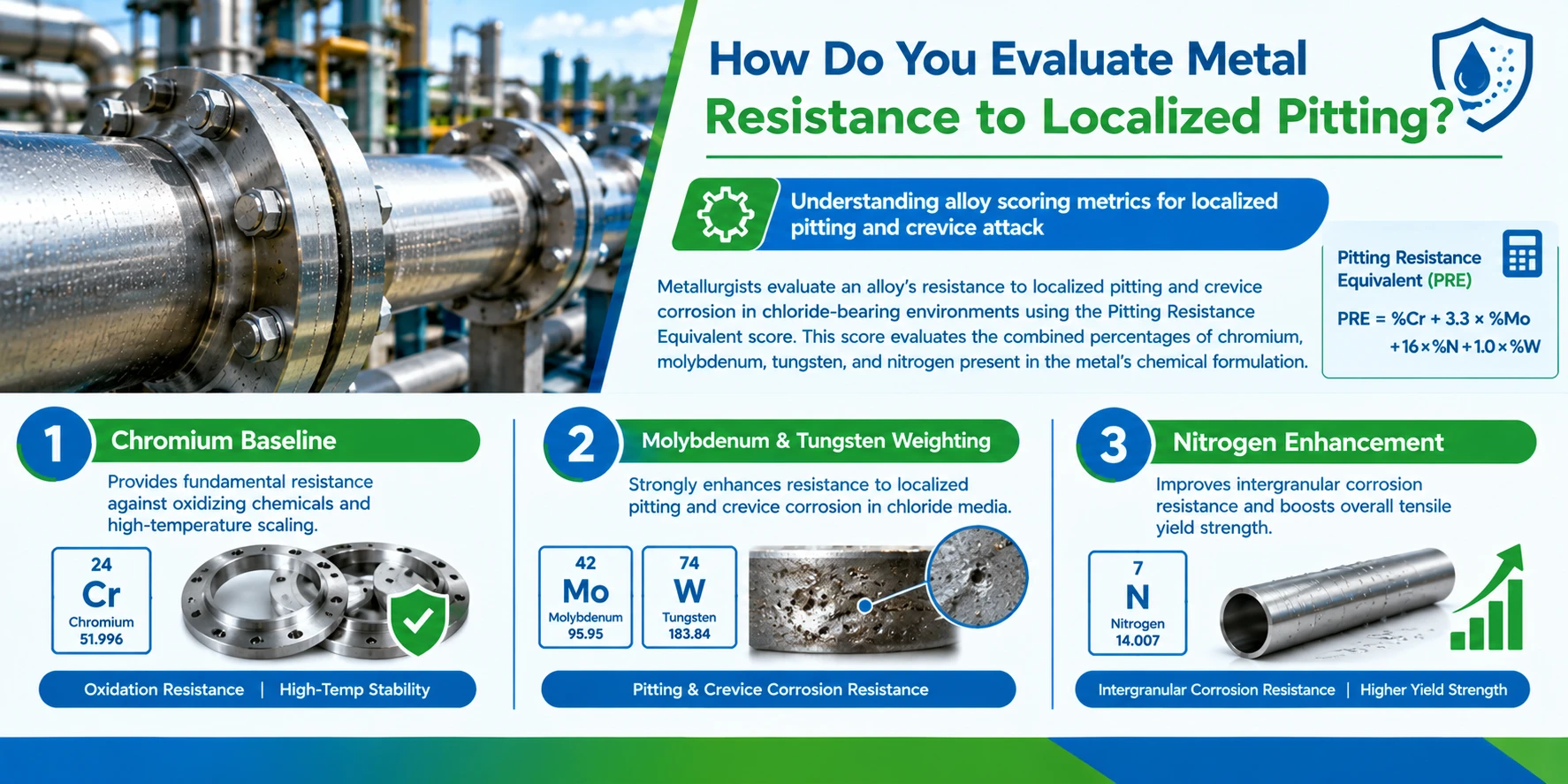
Understanding alloy scoring metrics for localized pitting and crevice attack
Metallurgists evaluate an alloy's resistance to localized pitting and crevice corrosion in chloride-bearing environments using the Pitting Resistance Equivalent score. This score evaluates the combined percentages of chromium, molybdenum, tungsten, and nitrogen present in the metal's chemical formulation.
Chromium baseline
Provides fundamental resistance against oxidizing chemicals and high-temperature scaling.
Molybdenum & Tungsten weighting
Strongly enhances resistance to localized pitting and crevice corrosion in chloride media.
Nitrogen enhancement
Improves intergranular corrosion resistance and boosts overall tensile yield strength.
Why high alloy scoring numbers matter in aggressive chemical streams
Higher scoring numbers indicate superior resistance to localized pinhole formation and crevice attack. While standard stainless grades show lower baseline scores, super-austenitic grades show higher scores, and high-nickel nickel-chromium-molybdenum alloys exceed standard ratings, providing complete immunity to chloride-induced pitting.
| Material Grade | Primary Alloy Composition | Resistance Score Range | Primary Environmental Performance |
|---|---|---|---|
| SS 316L | 17% Cr / 12% Ni / 2.5% Mo | ∼25 | Seawater, ambient chlorides, mild organic acids |
| Duplex 2205 | 22% Cr / 5% Ni / 3% Mo / 0.18% N | ∼35 | Brackish water, sour gas, moderate chloride streams |
| Hastelloy C276 | 57% Ni / 16% Cr / 16% Mo / 4% W | >60 | Wet chlorine gas, mixed acids, ferric chlorides |
| Hastelloy C22 | 56% Ni / 22% Cr / 13% Mo / 3% W | >65 | Severe oxidizing acid mixtures, nitric/hydrochloric blends |
Comparing stainless steel baselines against high-nickel alloy performance
Upgrading from standard stainless formulations to high-nickel superalloys fundamentally alters how the metal interacts with aggressive chemicals. High nickel content prevents chloride stress corrosion cracking, while high molybdenum balances keep the alloy stable across wide pH ranges.
Stress corrosion immunity
High nickel content eliminates stress corrosion cracking in hot chloride solutions.
Broad pH stability
High molybdenum levels maintain mechanical stability in both acidic and alkaline environments.
Extended service life
High-nickel alloys withstand years of chemical exposure where standard metals fail in weeks.
Which Nickel Alloy Should You Choose for Oxidizing vs. Reducing Acids?
Understanding the difference between oxidizing and reducing chemical environments
Selecting the correct Hastelloy grade depends on whether your chemical stream is oxidizing or reducing. Oxidizing chemicals contain oxygen ions that pull electrons from metal, while reducing chemicals consume oxide layers directly.
Oxidizing media
Requires high chromium content to maintain passivating oxide films in oxygen-rich acids.
Reducing media
Requires high molybdenum and nickel content to resist chemical dissolution without oxygen present.
Mixed acid systems
Requires a carefully balanced nickel-chromium-molybdenum formulation to handle fluctuating process chemistry.
Selecting versatile high-nickel alloys for mixed acid streams
For chemical plants processing unpredictable or mixed waste streams, versatile nickel-chromium-molybdenum alloys provide the broadest spectrum of corrosion protection.
When chemical processing units handle aggressive mixed acid streams, engineers rely on our corrosion-resistant Hastelloy C276 industrial forged flanges alongside our versatile Hastelloy C22 high-chromium flanges designed for superior oxidizing acid protection.
Hastelloy C276 versatility
High molybdenum and chromium balance resists both reducing and oxidizing contaminants.
Hastelloy C22 oxidation resistance
Elevated chromium content delivers exceptional protection in strongly oxidizing acid blends.
Weld zone stability
Low carbon content prevents grain-boundary precipitation during field welding.
Managing pitting and crevice corrosion under severe thermal exposure
Operating aggressive chemical systems at elevated temperatures accelerates chemical reaction rates and increases localized pitting risks. Choosing nickel alloys with tungsten additions locks the crystal matrix, preventing crevice attack beneath flange gaskets at high thermal loads.
Thermal acceleration
Corrosion rates double or triple with every incremental rise in process fluid temperature.
Tungsten stabilization
Additions of tungsten enhance crevice corrosion resistance in hot chemical baths.
Gasket seating safety
High yield strength maintains tight gasket seating stress across thermal cycles.
What Is the Best Alloy for Pure Hydrochloric and Sulfuric Acid Processing?
Specialized molybdenum-rich alloys for pure hydrochloric acid service
Hydrochloric acid is a strong reducing agent that rapidly destroys most industrial metals. Standard nickel-chromium alloys struggle in concentrated hydrochloric streams because chromium provides limited protection in non-oxidizing environments.
For dedicated chemical loops handling pure hydrochloric acid without oxidizing agents, plant operators specify Hastelloy B2 chemical process flanges to prevent rapid metal dissolution.
High molybdenum formulation
Contains high molybdenum proportions for exceptional resistance to hydrochloric acid.
Pure reducing focus
Formulated specifically for pure reducing acids across all concentrations and temperatures.
Contamination sensitivity
Requires careful process control to ensure oxidizing impurities are absent.
Copper-enhanced alloys designed specifically for sulfuric acid resistance
Sulfuric acid behavior changes dramatically depending on concentration and operating heat. While concentrated sulfuric acid is oxidizing at ambient conditions, diluted concentrations act as a strong reducing acid that attacks standard equipment.
When sulfuric acid concentration and temperature fluctuate in chemical plants, engineering teams trust our specialized Hastelloy C2000 corrosion-resistant flanges to maintain structural integrity.
Copper addition
Contains copper additions specifically engineered to enhance resistance to sulfuric acid solutions.
Wide concentration tolerance
Resists sulfuric acid attack from dilute concentrations up to hot concentrated streams.
Crevice protection
High chromium and molybdenum levels prevent localized pitting in stagnant acid zones.
Preventing stress corrosion cracking in aggressive chemical loops
Stress corrosion cracking occurs when tensile stress combines with a corrosive chemical environment, causing sudden brittle cracking in ductile metals. High-nickel formulations prevent this failure mechanism completely.
Nickel backbone
High nickel matrix provides complete protection against chloride-induced stress cracking.
Mechanical stability
Withstands high internal piping stresses without initiating micro-cracks.
Process safety
Eliminates sudden catastrophic pipeline splits in hazardous chemical loops.
How Do Advanced High-Temperature Alloys Handle Extreme Thermal Stress?
Thermal stability and grain boundary protection at elevated temperatures
Some chemical operations expose piping components to simultaneous chemical corrosion and extreme heat. Under continuous high thermal exposure, standard alloy grains can coarsen, precipitating secondary phases along grain boundaries that lower corrosion resistance.
For high-heat industrial reactors requiring exceptional thermal stability without boundary precipitation, facilities rely on Hastelloy C4 high-temperature flanges.
Controlled microstructure
Titanium and low-carbon additions prevent harmful phase precipitation at high thermal ranges.
Ductility retention
Maintains high impact toughness and flexibility after long-term heat exposure.
Welded reliability
Suitable for direct post-weld service without requiring complex solution annealing.
Furnace ducts, gas turbines, and extreme oxidation resistance
When industrial processes transition from liquid chemical streams to high-temperature gas streams, oxidation, carburization, and thermal creep become the primary failure threats.
When combustion systems and furnace ducts operate under extreme heat and oxidation, contractors specify heavy-duty Hastelloy X oxidation-resistant flanges to resist high-temperature creep.
High-temperature oxidation barrier
Forms a stable surface oxide scale that resists flaking at elevated temperatures.
Carburization resistance
Protects internal ductwork in petrochemical cracking furnaces and gas turbine exhaust lines.
Creep rupture strength
Maintains structural load capacity under continuous high-temperature mechanical stress.
Creep resistance and structural integrity under prolonged thermal cycling
Thermal cycling in furnace applications causes standard metals to warp, distort flange facings, and loosen stud bolting. High-performance nickel alloys retain high yield strength across extreme thermal swings, ensuring leak-free performance.
Thermal fatigue resistance
Withstands repeated heating and cooling cycles without surface cracking.
Low thermal expansion
Matches expansion characteristics of companion alloy components to preserve bolt tension.
Long service life
Reduces maintenance frequency in thermal processing units and gas scrubbers.
How Does Ganpat Metal Ensure Chemical Alloy Integrity and Traceability?
Verifying ladle chemical analysis and mill test certifications
Given the high material cost and critical safety role of nickel superalloys, verifying chemical composition is essential. At Ganpat Metal, every raw heat undergoes rigorous ladle chemical analysis before machining.
Chemical verification
Confirming exact nickel, chromium, molybdenum, tungsten, and carbon percentages.
Heat segregation
Storing nickel alloy inventory in dedicated holding areas to prevent material cross-contamination.
Complete documentation
Providing verified EN 10204 3.1 material test reports with every customer shipment.
Non-destructive testing and Positive Material Identification protocols
To guarantee zero material mix-ups, Ganpat Metal enforces complete Positive Material Identification testing on all finished high-alloy components before packaging.
| NDT Inspection Procedure | Test Execution Method | Verified Material Quality Parameter |
|---|---|---|
| PMI Spectro-Scan | X-Ray Fluorescence (XRF) / OES | Exact alloy chemical percentage verification |
| Ultrasonic Testing (UT) | High-frequency sound wave scan | Complete absence of internal forging voids or cracks |
| Dimensional Inspection | Precision digital caliper / CMM audit | Exact ASME B16.5 flange facing and bolt hole tolerances |
| Liquid Penetrant (LPI) | Fluorescent dye surface audit | Zero surface micro-fissures or machining cracks |
Interactive Tool & Trusting Ganpat Metal for Severe Chemical Components
Use the interactive guide below to match your chemical media to the correct nickel alloy specification before placing your project order:
Interactive Chemical Environment & Alloy Selector Tool
Step 1: Identify Your Primary Chemical Media
Hastelloy C276 Flanges (ASME B16.5)
Universal chemical processing alloy with excellent resistance to pitting, stress corrosion cracking, and oxidizing/reducing acids.
Selector Summary: Matching your chemical chemistry to the correct alloy ensures zero corrosion failure.
Partnering with Ganpat Metal gives your facility access to certified, ready-to-ship nickel alloy components that satisfy strict international specifications. To review complete dimensional tables, pressure classes, and material specifications across all product lines, return to our master ASME B16.5 flange dimension and rating guide.